Ding-dong
*pause*
Ding-dong knock knock knock
*long pause*
Ding-dong ding-dong knock knock knock knock knock knock knock knock ah, you are in. I thought I could see you moving about in there, ha ha! Milk no sugar, before you ask.
OK, well, hello, I’m Sheersy and I’m just canvassing the area to see whether you’ll be voting for me in the upcoming – and, let’s face it, highly anticipated – General Election. I’m running on a benevolent Stalinist agenda that prizes fear and confused obedience above all other qualities. That’s not to say that I’ll be an entirely cruel supreme master, er, democratically elected leader, but I’d urge you to concentrate less on the ‘benevolent’ and more on the ‘Stalinist’, if you know what’s good for you. It’s a long-held aim of mine to reimagine the carrot/stick equation and then eat my big orange bat afterwards to dispose of the evidence, that’s all I’m saying.
My most noteworthy policies - the four sturdy pillars of my leadership bid - are as follow:
Pimp all rides Britain’s roads are boring. Just go for a drive – or, hey, even a walk – and see how excited you get. Clue: not very. Silver car, silver car, silver car – oh look, a red car - silver car. Boring. “But it helps hide the dirt.” BOOOOORRIIIIIIINNNG. Now try this: chrome rims, hydraulics, Cherry Bomb exhaust, custom paint job, blown engine, sick sound system. Why you whip be rollin’ on they lame-ass biscuits, dog? Precisely.
Bring back dinosaurs The worldwide annual budget for space exploration is an estimated 35 thousand million pounds. Yikes, that’s some serious money. We should be sending out sleek, hyperdrive-powered starliners like spores from some overactive puffball by now, right? Uh, no. In fact, we’ve only just about been to the moon a grand total of six times in the last 50-odd years. If this were a private company, the shareholders would be asking searching and pertinent questions like “Where’s my jetpack?” This simply isn’t paying the sci-fi dividends we were promised. Enough is enough, it’s time to knock this space bunk on the head and try a different tack. Let’s plough that sweet mountain of cash into questionable, carte blanche genetic projects run by disavowed and quite possibly unhinged scientists on remote tropical islands and see what they come up with.
Give our athletes some ‘pep’ Our fine sportsmen and women have a really tough time navigating the labyrinthine drug laws enforced by such bodies as the planned National Anti-Doping Agency, at the same time as trying to get some kind of product licensing deal [AKA genuine income] off the ground. Aah, poor them. In addition to that, as a group they’re not generally known for their incisive, high-brow appraisal of any given situation. “Coach said those special vitamins would be good for me, but now the unfriendly men want to stick me full of pins and make me wee in a cup.” They’re more like livestock, really. Now watch the over-toned idiots run round and round a track: yawnarama. Let’s scrap all this anti-doping nonsense, pump them full of all sorts of experimental concoctions and watch the fireworks. Eat my dust, Bannister, you four-minute-mile loser! Think of the military applications. It’s win-win, smiles all round.
Ban golf Take that Pringle-sweater-having, tasselled-shoe-wearing, self-important, new money waste of everybody’s time and effort underground and maybe, just maybe, like the London Orbital warehouse raves of the early ‘90s, it might become vaguely interesting. But I doubt it.
It’s a revolutionary approach, I grant you, but hope you’ll see sense and opt for my policies over those of the other [what I like to call ‘lesser’] candidates. Remember: vote Sheersy!
Thanks for the tea - I’ll see myself out.
Thursday, 15 April 2010

Friday, 5 March 2010
BBC 6 Music
An email to the BBC Trust - srconsultation@bbc.co.uk - regarding the proposal in the BBC Strategy Review March 2010 that 6 Music should be axed in 2011:
Dear Sir/Madam,
I feel compelled to write to you regarding the frankly devastating news that the BBC is considering closing their digital radio station 6 Music.
When the BBC launched the station in 2002, I'm sure I wasn't alone in thinking it was too good to be true. There I was dutifully paying my licence fee for the odd Attenborough series and, well, not much else, to be quite honest. News? Channel 4. Quality drama? HBO. Comedy? Behave - Two Pints is an absolute travesty, beloved only of unapologetic knuckleheads.
Then along comes a more eclectic, less chart-oriented XFM with no adverts and bingo bango, the BBC's finally putting out something that genuinely appeals to me. Not only sporadically, either, but pretty much all day long. 6 Music has continually attracted talented, erudite and witty broadcasters, including respected, cutting-edge comedians and musicians, to front their shows. The line-up of presenters past and present [with, granted, the notable exception of George Lamb] reads like some kind of wish fulfilment fantasy, and Adam and Joe's Saturday show is honest-to-God gold dust.
The question the BBC should be asking itself is whether it can afford to cut 700,000 fanatical 6 Music listeners loose in order to save 10 times that fathead Moyles's pie allowance, which fantastic sum seems inversely commensurate with the recipient's lack of talent. It's not going to be a case of "Oh well, it was good while it lasted - now let's see what else the BBC's got to offer," because the goodwill of 6 Music's audience will have been squandered and they'll seek similar content elsewhere. The Director-General's Strategy Review would seem to suggest that 6 Music's fan base would naturally gravitate - or else could be gently shepherded - towards Radios 1 and 2, but Radio 1's daytime output is far too moronic for the 6 Music listenership, and Radio 2 seems geared [with apologies to my parents] towards middle-aged nostalgia addicts. Music is one of those things that people are illogically passionate about, and to assume that we'll make do with a vague approximation of our preferences just won't cut it in this digital age of unprecedented choice.
I can't help but feel, too, that this is a disappointing, token gesture of appeasement on the part of the BBC to the well-documented pressure the Tories have recently been placing on the corporation. Government agencies and publicly-funded bodies are tripping over themselves to second-guess the uptight fun-haters everyone seems to think will be in government in but a few short months. It would appear naïve in the extreme, however, for anyone to believe that the proposed cuts will sate those who already have the scent of blood in their nostrils, and that this wouldn't in fact herald the start of an almighty feeding frenzy, to be accompanied by increasingly self-confident cries for further scapegoats.
The BBC offers a broad and unique selection of programmes, the like of which simply isn't on offer amongst its commercial competitors. Streamlining those diverse - and by their very nature often niche - services can surely only result in a general lack of distinction from all the other bland, lowest-common-denominator fare on the market.
Yours faithfully,
Happy Gin Face
P.S. Charlie Brooker for Director-General! Whoop whoop!
Dear Sir/Madam,
I feel compelled to write to you regarding the frankly devastating news that the BBC is considering closing their digital radio station 6 Music.
When the BBC launched the station in 2002, I'm sure I wasn't alone in thinking it was too good to be true. There I was dutifully paying my licence fee for the odd Attenborough series and, well, not much else, to be quite honest. News? Channel 4. Quality drama? HBO. Comedy? Behave - Two Pints is an absolute travesty, beloved only of unapologetic knuckleheads.
Then along comes a more eclectic, less chart-oriented XFM with no adverts and bingo bango, the BBC's finally putting out something that genuinely appeals to me. Not only sporadically, either, but pretty much all day long. 6 Music has continually attracted talented, erudite and witty broadcasters, including respected, cutting-edge comedians and musicians, to front their shows. The line-up of presenters past and present [with, granted, the notable exception of George Lamb] reads like some kind of wish fulfilment fantasy, and Adam and Joe's Saturday show is honest-to-God gold dust.
The question the BBC should be asking itself is whether it can afford to cut 700,000 fanatical 6 Music listeners loose in order to save 10 times that fathead Moyles's pie allowance, which fantastic sum seems inversely commensurate with the recipient's lack of talent. It's not going to be a case of "Oh well, it was good while it lasted - now let's see what else the BBC's got to offer," because the goodwill of 6 Music's audience will have been squandered and they'll seek similar content elsewhere. The Director-General's Strategy Review would seem to suggest that 6 Music's fan base would naturally gravitate - or else could be gently shepherded - towards Radios 1 and 2, but Radio 1's daytime output is far too moronic for the 6 Music listenership, and Radio 2 seems geared [with apologies to my parents] towards middle-aged nostalgia addicts. Music is one of those things that people are illogically passionate about, and to assume that we'll make do with a vague approximation of our preferences just won't cut it in this digital age of unprecedented choice.
I can't help but feel, too, that this is a disappointing, token gesture of appeasement on the part of the BBC to the well-documented pressure the Tories have recently been placing on the corporation. Government agencies and publicly-funded bodies are tripping over themselves to second-guess the uptight fun-haters everyone seems to think will be in government in but a few short months. It would appear naïve in the extreme, however, for anyone to believe that the proposed cuts will sate those who already have the scent of blood in their nostrils, and that this wouldn't in fact herald the start of an almighty feeding frenzy, to be accompanied by increasingly self-confident cries for further scapegoats.
The BBC offers a broad and unique selection of programmes, the like of which simply isn't on offer amongst its commercial competitors. Streamlining those diverse - and by their very nature often niche - services can surely only result in a general lack of distinction from all the other bland, lowest-common-denominator fare on the market.
Yours faithfully,
Happy Gin Face
P.S. Charlie Brooker for Director-General! Whoop whoop!
Monday, 22 February 2010
Über alles
Just back from a short break in Germany.
I was staying with an old schoolfriend who's been working for the MOD since leaving university and is currently on secondment to NATO at the JHQ Rheindalen military base. He assures me he is but a lowly data analyst, but he's signed the Official Secrets Act and I honestly couldn't begin to guess what he actually does on a day-to-day basis. There's every possibility that he's involved in deniable ops, so just to be on the safe side I'll identify him only as Mr. L [I was going to advertise his PS3 username, but that's probably still enough for him to be contacted through PlayStation Network and "persuaded" by whoever the other side is these days. Blimey, you never can tell in this game, can you?].
JHQ Rheindalen is a truly bizarre place - a vast, town-sized network of semi-detached properties that physically resembles an eerily underpopulated Chatsworth Estate from Shameless and is uniformly rendered in that green-tinged light grey so beloved of Cold War decorators. Featuring such incongruous street names as Queens Avenue and Cumberland Drive, it's a surreally skewed slice of British life planted slap bang in the middle of Europe, with its own shopping arcade, supermarkets and cinema: The Truman Show with added squaddies. Apparently the local town on pay day is a mass brawl waiting to happen, with hordes of both local and military police on patrol just waiting for it to kick off.
Outside the regimented Petri dish of existence on base, German life is noticeably cleaner, more efficient and more polite than its English equivalent. Mr. L's theory is that you're more likely to respect other people when you respect yourself, which, if true, would be a compound rule that draws impetus from all facets of cultural identity. For instance: in marked contrast to our once-competitive industries, German manufacturing is still a force to be reckoned with - a fact that can readily be deduced at the airport drop-off rank, where a steady stream of VWs, Audis, BMWs and Mercedes makes up a conspicuously high percentage of the road-going traffic. German people evidently buy German brands over and above anything else on the market, in the relative certainty that the product has been sourced, forged and marketed domestically. Our home-grown brands, meanwhile, have been brazenly flogged off for a transitory profit. Still, at least we won World War II, eh? And the World Cup in '66. In your face, Germany!
Another point of interest - not unrelated to the above observation - is the fact that Germany's Autobahn features numerous entirely unrestricted stretches: the road sign to the left heralds a section of road where there is literally no speed limit. In a country where every other car is a high-end Merc or Beamer, this means that the general pace on the roads is in an altogether different league. As a perhaps unsurprising consequence of this, German drivers are incredibly aware and will quickly pull over if a more capable vehicle signals its intention to overtake [usually by roaring up behind you and then sitting on your arse until you get out of the way]. Mr. L is a confirmed speed freak and once took the opportunity to fly as a passenger in a BAe Hawk T1(A) - of Red Arrows fame - the unprecedented G-Force of which caused him to yack his NAAFI lasagne up all over the inside of the cockpit. Needless to say, the hands-off approach of the German road system rather appeals to his get-there-quick sensibilities. "We're doing twice the UK speed limit," he said to me at one point, as distant objects in front of his 5l supercharged V8 Jag - I think they might have been other cars - became close objects in improbably short order. I could just about acknowledge this with a strained "Nng," and was about to add that I was sure it was 70mph for a reason, when he decided that we might need to up the ante slightly. Not much, just another 20 miles an hour or so. My facial expression contracted into an entirely involuntary rictus and, had I been able to tear my terrified gaze from the road for long enough, I'm pretty sure I could have located the individual sweat glands in the palms of my hands simply by tracing the gushing rivulets of adrenaline-rich perspiration to their roots.
 The unalloyed fear was all worthwhile, however, as I'd traded five years of my life in for a delightful trip to the Mosel Valley, where much of Germany's white wine and Sekt is produced. This is an aesthetically aggreeable region typified by chalet-style architecture, impossibly steep
  vineyards and at least one imposing hilltop castle, the Reichsurg Cochem, whose gothic spires dominate this picture postcard panorama. We followed this with dinner in the revolving restaurant at the top of Düsseldorf's Fernsehturm and - just to bring me crashing figuratively as well as literally back to Earth - a tour of some of cheesiest late bars I've ever experienced.
Yes, the UK's industrial machine may be in tatters, but at least we've got the clubbing scene sussed. In your face, Germany! Feel the burn!
I was staying with an old schoolfriend who's
 been working for the MOD since leaving university and is currently on secondment to NATO at the JHQ Rheindalen military base. He assures me he is but a lowly data analyst, but he's signed the Official Secrets Act and I honestly couldn't begin to guess what he actually does on a day-to-day basis. There's every possibility that he's involved in deniable ops, so just to be on the safe side I'll identify him only as Mr. L [I was going to advertise his PS3 username, but that's probably still enough for him to be contacted through PlayStation Network and "persuaded" by whoever the other side is these days. Blimey, you never can tell in this game, can you?].
JHQ Rheindalen is a truly bizarre place - a vast, town-sized network of semi-detached properties that physically resembles an eerily underpopulated Chatsworth Estate from Shameless and is uniformly rendered in that green-tinged light grey so beloved of Cold War decorators. Featuring such incongruous street names as Queens Avenue and Cumberland Drive, it's a surreally skewed slice of British life planted slap bang in the middle of Europe, with its own shopping arcade, supermarkets and cinema: The Truman Show with added squaddies. Apparently the local town on pay day is a mass brawl waiting to happen, with hordes of both local and military police on patrol just waiting for it to kick off.
Outside the regimented Petri dish of existence on base, German life is noticeably cleaner, more efficient and more polite than its English equivalent. Mr. L's theory is that you're more likely to respect other people when you respect yourself, which, if true, would be a compound rule that draws impetus from all facets of cultural identity. For instance: in marked contrast to our once-competitive industries, German manufacturing is still a force to be reckoned with - a fact that can readily be deduced at the airport drop-off rank, where a steady stream of VWs, Audis, BMWs and Mercedes makes up a conspicuously high percentage of the road-going traffic. German people evidently buy German brands over and above anything else on the market, in the relative certainty that the product has been sourced, forged and marketed domestically. Our home-grown brands, meanwhile, have been brazenly flogged off for a transitory profit. Still, at least we won World War II, eh? And the World Cup in '66. In your face, Germany!
Another point of interest - not unrelated to the above observation - is the fact that Germany's Autobahn features numerous entirely unrestricted stretches:
 the road sign to the left heralds a section of road where there is literally no speed limit. In a country where every other car is a high-end Merc or Beamer, this means that the general pace on the roads is in an altogether different league. As a perhaps unsurprising consequence of this, German drivers are incredibly aware and will quickly pull over if a more capable vehicle signals its intention to overtake [usually by roaring up behind you and then sitting on your arse until you get out of the way]. Mr. L is a confirmed speed freak and once took the opportunity to fly as a passenger in a BAe Hawk T1(A) - of Red Arrows fame - the unprecedented G-Force of which caused him to yack his NAAFI lasagne up all over the inside of the cockpit. Needless to say, the hands-off approach of the German road system rather appeals to his get-there-quick sensibilities. "We're doing twice the UK speed limit," he said to me at one point, as distant objects in front of his 5l supercharged V8 Jag - I think they might have been other cars - became close objects in improbably short order. I could just about acknowledge this with a strained "Nng," and was about to add that I was sure it was 70mph for a reason, when he decided that we might need to up the ante slightly. Not much, just another 20 miles an hour or so. My facial expression contracted into an entirely involuntary rictus and, had I been able to tear my terrified gaze from the road for long enough, I'm pretty sure I could have located the individual sweat glands in the palms of my hands simply by tracing the gushing rivulets of adrenaline-rich perspiration to their roots.
 The unalloyed fear was all worthwhile, however, as I'd traded five years of my life in for a delightful trip to the Mosel Valley, where much of Germany's white wine and Sekt is produced. This is an aesthetically aggreeable region typified by chalet-style architecture, impossibly steep
  vineyards and at least one imposing hilltop castle, the Reichsurg Cochem, whose gothic spires dominate this picture postcard panorama. We followed this with dinner in the revolving restaurant at the top of Düsseldorf's Fernsehturm and - just to bring me crashing figuratively as well as literally back to Earth - a tour of some of cheesiest late bars I've ever experienced.
Yes, the UK's industrial machine may be in tatters, but at least we've got the clubbing scene sussed. In your face, Germany! Feel the burn!
Tuesday, 9 February 2010
Dave's new reading list
A friend of mine - let's call him 'Dave' - recently [well, not that recently, but I've done it now so shut up] asked me for some comic and graphic novel recommendations. I've skipped the obvious ones - V For Vendetta, Watchmen, The Dark Knight Returns - because if you haven't read them, then frankly you haven't done your homework and you should be thoroughly ashamed.
You'll notice that several writers crop up regularly throughout my list. They are 2000AD alumni Alan Moore, Bryan Talbot, Grant Morrison, Warren Ellis and Mark Millar. I routinely buy multiple copies of anything illustrated by Frank Quitely, because the man is a demiurge of sequential art.
I've split my recommendations into handy sub-sections: Spandex, Steam, Horror and We3 [curse you, pesky genre-straddling Grant Morrison!]. That way, if you're so not about the capes right now, you can just skip on to the next section. If none of these sub-headings appeals, then you're probably reading the wrong blog.
Dave: this supersedes any and all previous reading lists. If you are in the middle of a book, stop reading it IMMEDIATELY and pick up of one of the following:
SPANDEX
 Miracleman [w: Alan Moore a: various] Written for UK's Warrior magazine around the same time as V For Vendetta, this is British legend Alan Moore's final word on real-world superheroics, with the titular hero testing the limits of his powers and responsibilities aided and/or hindered by a colourful supporting cast of allies and enemies. Worth reading if only to experience the third volume - Olympus - which is beautifully illustrated by John Totleben and charts Miracleman's systematic construction of the ideal human society. It also features one of the most horrific superhuman battles in comics history, with London destroyed and millions dead. Miracleman has been subject to protracted legal wrangling over character ownership since the mid-'80s, making the now out-of-print collections largely unobtainable.
 The Killing Joke [w: Alan Moore a: Brian Bolland] The Joker escapes from Arkham Asylum and goes after Batman's closest allies in this seminal tale. The compact story is by Alan Moore, who develops the character of the Caped Crusader's pallid, grinning nemesis more credibly in fifty pages than any number of writers had done over the preceding fifty years. The slick, precise linework constitutes rare interior illustration by superstar cover artist Brian Bolland, who was among the many talented 2000AD creators to be harvested by big American firms in the early- to mid-'80s. The Killing Joke was recently recoloured and retouched by Bolland for a 20th anniversary hardback.
 Zenith [w: Grant Morrison a: Steve Yeowell] Morrison is one of the biggest writers in the business - in some respects Alan Moore's natural heir, albeit with his own distinct line in psychedelic metafiction. Before he started mucking the hero genre about in earnest, he wrote this straightforward but superior hero series for 2000AD: Zenith is a spoilt, egotistical pop star, the son of two now-missing '60s heroes, who gets dragged against his will into a plot involving Nazi superhumans and evil extradimensional entities. The third volume features cameos from pretty much every British superhero since the '50s [see the International Catalogue of Superheroes' handy Zenith Phase Three Scorecard for further information]. Now out of print and quite tricky to get hold of, due to Morrison having instigated a legal wrangle over creative rights.
 Brat Pack [w/a: Rick Veitch] A long-time collaborator of Alan Moore's, Veitch had previously taken over writing Swamp Thing when Moore left the title. His growing disillusionment with the aggressive commercial aspects of the business fuelled a series of satirical takes on costumed heroics, of which this is the first. Brat Pack explores the dubious notion of kid sidekicks, following four raw recruits through their brutal inductions by variously irresponsible and psychopathic 'heroes'. Ugly and nasty, yes, but it's a beautifully crafted labour of simmering resentment, packed with great character design and succinctly iconic imagery.
 Flex Mentallo [w: Grant Morrison a: Frank Quitely] Morrison's first collaboration with the sublime Frank Quitely is a perfectly-formed piece of glossy metafiction. Each issue channels the four distinct eras of US comics [Golden Age, Silver Age, Dark Age and Modern Age], all framed within a surreal missing superpersons detective story. Never collected, due to legal wrangling over Mentallo's Charles Atlas-like physical appearance and, more specifically, secret origin [which actually appeared in Doom Patrol #42, fact fans!], although I had my individual issues hardback bound by dpbanks.com. That's right, now you're envious.
 The Authority [w: Warren Ellis/Mark Millar a: Bryan Hitch/Frank Quitely/various] This eponymous superteam are answerable to no-one - the heaviest hitters in the Wildstorm Universe, they live aboard a sentient interdimensional spaceship the size of a city and don't hesitate to come down on their enemies like a ton of wet shit. Warren Ellis's incarnation of the team took on supervillains and scaled-up space-borne threats, but for my money Mark Millar's take was their finest hour - a collection of flawed beings with god-like powers, revelling in their celebrity status, indulging in Caligulan parties and setting corrupt terrestrial governments straight with loads of stick and not much carrot.

Well, quite.
If you like this brand of OTT, so-called "real world" superheroics, you'll lap up Cla$$war, The Ultimates, Wanted, Kick-Ass, Black Summer, No Hero, Supergod, Nemesis, et cetera, ad nauseam.
 Planetary [w: Warren Ellis a: John Cassaday] I've already written at some length about this title, but in summary this is the cerebral counterpart to the audacious hyperbole of The Authority. A trio of idiosyncratic superhumans heads up the enigmatic and phenomenally wealthy Planetary organization, dedicated to unearthing otherworldly secrets that are all but lost to posterity. Ellis's script ties a host of pop culture references - Godzilla, '50s B-movies, Hong Kong ghosts - into a single continuum, while John Cassaday's character and environment design brings to the proceedings a disquietingly unique aesthetic.
STEAM
 From Hell [w: Alan Moore a: Eddie Campbell] This dense speculative history of the Jack the Ripper murders is the size of a phone directory and commensurately ambitious in scope. Campbell's scratchy monochrome inks perfectly suit the gaslit squalor of late 19th-century London, while Moore insinuates his story into more well-documented, historically accurate events, most obviously the five grisly murders perpetrated by the Ripper; his sizeable cast of characters similarly interacts with period figures such as Queen Victoria and Joseph Merrick, the Elephant Man.
 The League of Extraordinary Gentlemen [w: Alan Moore a: Kevin O'Neill] The neat central premise concerns Victorian oddities from various literary works being recruited for outlandish black bag work by the British government. Moore's scripts tie a dizzying host of fictional works together [in later instalments, for example, Chitty Chitty Bang Bang is an early prototype of Knight Rider's KITT], while pretty much every tiny background detail in Kevin O'Neill's illustration alludes to a period character or concept. American writer Jess Nevins has made extensive annotations to accompany each volume, with definitive explanations of even the most obscure reference.
 The Adventures of Luther Arkwright [w/a: Bryan Talbot] This dense steampunk saga has foppish Royalists using souped-up First World War technology to engage fascistic Roundheads across a host of parallel Earths. With a tip of the hat to Moorcock's Jerry Cornelius, Talbot fleshes out his labyrinthine plot with richly detailed black-and-white illustration and extended, bloody action sequences, painstakingly rendered in Peckinpah-esque bullet-time. The full-colour sequel, Heart of Empire, is also worth picking up.
 Scarlet Traces [w: Ian Edginton a: D'Israeli] A steampunk sequel to H.G. Wells' The War of the Worlds, originally serialized as a webcomic. Gentleman adventurer and war hero Major Robert Autumn investigates the brutal murders and disappearances of young women against the backdrop of a Victorian England awash with acquired Martian technology. The same creative team have since adapted Wells' original in the same style, and there's a sequel, The Great Game [so, confusingly, this is the middle episode of a trilogy].
 Grandville [w/a: Bryan Talbot] In part an homage to the anthropomorphic illustration of French caricaturist Jean Ignace Isidore Gérard, who worked under the pseudonym J.J. Grandville, this is also inspired - according to Talbot - by Conan Doyle, Rupert Bear and Quentin Tarantino. Detective Inspector LeBrock, a rough-and-ready Scotland Yard badger, embarks on a period romp with lashings of old-fashioned fisticuffs. This oversized hardback is one of the most attractive editions ever to have graced my bookshelves.
HORROR
 Swamp Thing [w: Alan Moore a: various] DC's third-rate '70s muck monster was reinvented by Alan Moore as a sentient plant-god in this cerebral horror series. Shortly after Moore took the reins, this was the first mainstream US title to completely discard its stamp of approval from the Comics Code Authority - a censorship organization formed in the wake of the creative witch-hunts of the '50s - clearing the way for more considered, adult content aimed at a mature and literate readership. Moore's Swamp Thing is also notable for having introduced roguish magician John Constantine - who's actually a foul-mouthed, blond scouser, not some raven-haired LA woodentop who gives up smoking at the first whiff of sulphur. Keanu Reeves, I'm looking at you.
 Uzumaki [w/a: Junji Ito] There's no shortage of top-notch scares in manga and this is one of the creepiest Eastern offerings on the market. Ito's three collections detail the insidious takeover of a small lakeside town by malevolent spiral patterns, beginning on a small-scale with individual obsession and insanity but quickly assuming apocalyptic proportions, with gangs of physically twisted lunatics on the prowl and rampant typhoons decimating everything in their path. Heavily influenced by the cosmic horror of H.P. Lovecraft, the overriding atmosphere throughout Uzumaki is one of impossible, alien infection, against which the few remaining sane protagonists are ultimately powerless.
 The Walking Dead [w: Robert Kirkman a: Charlie Adlard] Kirkman is on record as saying that he won't be wrapping up his zombie apocalypse opus any time soon, which is great news for fevered deadheads like me. If you've ever wondered what happens after the credits of a zombie movie have rolled, here's your definitive answer. It's an HBO-style, character-driven series that understands the fundamentals of the zombie horror: by all means barricade the windows against the flesh-eating dead, but keep an even closer eye on your fellow survivors. Don't get too attached to any of the characters, either - Kirkman likes nothing better than to continually wrong-foot his readers in the most unexpected ways possible. I've lost count of the number of times I've cursed his sick name while reading this. Also benefits from the solid, gritty black-and-white artwork of Charlie Adlard, one of the new school of 2000AD Brits currently making a Stateside name for themselves.
 Girls [w/a: The Luna Brothers] Rather like Stephen King's latest doorstop, The Lunas' high-concept horror has an impenetrable dome suddenly enclosing an all-American town, with increasingly disturbing consequences. Unlike Stephen King's latest breeze block, this particular town is subsequently overrun by attractive naked women. Aggressive towards women and irresistible to men, these blank-minded clones quickly replicate themselves after intercourse [by laying eggs] in order to serve something rather disturbing that has crash-landed out in one of the cornfields... Tensions soon run high inside the dome as realization dawns and the struggle for survival cranks up several notches. Quite harsh. The same creative team are currently halfway through The Sword, an immensely entertaining action fantasy that's also well worth a look.
WE3
 We3 [w: Grant Morrison a: Frank Quitely] Gets its own section because I don't really know what it is: near-future dystopian satire, experimental animal rights manifesto or post-Matrix sci-fi action adventure? Grant Morrison and Frank Quitely's mini-series is a mere pamphlet compared to some of the dense tomes featured above, but it's a killer example of the medium's potential. The simple plot revolves around three domestic animals - dog, cat and rabbit - who escape, along with their state-of-the-art cybernetic warsuits, from a top secret military program and attempt to make their way back home. Even Morrison's pet-centric emotional manipulation takes a back seat to Quitely's jaw-dropping, time-sliced action sequences and insane levels of razor sharp detail.
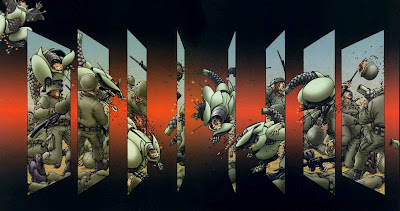
Absolutely essential reading for anyone, much less comic fans.
Right, that's your lot - now get your sorry arse off to Amazon.
You'll notice that several writers crop up regularly throughout my list. They are 2000AD alumni Alan Moore, Bryan Talbot, Grant Morrison, Warren Ellis and Mark Millar. I routinely buy multiple copies of anything illustrated by Frank Quitely, because the man is a demiurge of sequential art.
I've split my recommendations into handy sub-sections: Spandex, Steam, Horror and We3 [curse you, pesky genre-straddling Grant Morrison!]. That way, if you're so not about the capes right now, you can just skip on to the next section. If none of these sub-headings appeals, then you're probably reading the wrong blog.
Dave: this supersedes any and all previous reading lists. If you are in the middle of a book, stop reading it IMMEDIATELY and pick up of one of the following:
SPANDEX
 Miracleman [w: Alan Moore a: various] Written for UK's Warrior magazine around the same time as V For Vendetta, this is British legend Alan Moore's final word on real-world superheroics, with the titular hero testing the limits of his powers and responsibilities aided and/or hindered by a colourful supporting cast of allies and enemies. Worth reading if only to experience the third volume - Olympus - which is beautifully illustrated by John Totleben and charts Miracleman's systematic construction of the ideal human society. It also features one of the most horrific superhuman battles in comics history, with London destroyed and millions dead. Miracleman has been subject to protracted legal wrangling over character ownership since the mid-'80s, making the now out-of-print collections largely unobtainable.
 The Killing Joke [w: Alan Moore a: Brian Bolland] The Joker escapes from Arkham Asylum and goes after Batman's closest allies in this seminal tale. The compact story is by Alan Moore, who develops the character of the Caped Crusader's pallid, grinning nemesis more credibly in fifty pages than any number of writers had done over the preceding fifty years. The slick, precise linework constitutes rare interior illustration by superstar cover artist Brian Bolland, who was among the many talented 2000AD creators to be harvested by big American firms in the early- to mid-'80s. The Killing Joke was recently recoloured and retouched by Bolland for a 20th anniversary hardback.
 Zenith [w: Grant Morrison a: Steve Yeowell] Morrison is one of the biggest writers in the business - in some respects Alan Moore's natural heir, albeit with his own distinct line in psychedelic metafiction. Before he started mucking the hero genre about in earnest, he wrote this straightforward but superior hero series for 2000AD: Zenith is a spoilt, egotistical pop star, the son of two now-missing '60s heroes, who gets dragged against his will into a plot involving Nazi superhumans and evil extradimensional entities. The third volume features cameos from pretty much every British superhero since the '50s [see the International Catalogue of Superheroes' handy Zenith Phase Three Scorecard for further information]. Now out of print and quite tricky to get hold of, due to Morrison having instigated a legal wrangle over creative rights.
 Brat Pack [w/a: Rick Veitch] A long-time collaborator of Alan Moore's, Veitch had previously taken over writing Swamp Thing when Moore left the title. His growing disillusionment with the aggressive commercial aspects of the business fuelled a series of satirical takes on costumed heroics, of which this is the first. Brat Pack explores the dubious notion of kid sidekicks, following four raw recruits through their brutal inductions by variously irresponsible and psychopathic 'heroes'. Ugly and nasty, yes, but it's a beautifully crafted labour of simmering resentment, packed with great character design and succinctly iconic imagery.
 Flex Mentallo [w: Grant Morrison a: Frank Quitely] Morrison's first collaboration with the sublime Frank Quitely is a perfectly-formed piece of glossy metafiction. Each issue channels the four distinct eras of US comics [Golden Age, Silver Age, Dark Age and Modern Age], all framed within a surreal missing superpersons detective story. Never collected, due to legal wrangling over Mentallo's Charles Atlas-like physical appearance and, more specifically, secret origin [which actually appeared in Doom Patrol #42, fact fans!], although I had my individual issues hardback bound by dpbanks.com. That's right, now you're envious.
 The Authority [w: Warren Ellis/Mark Millar a: Bryan Hitch/Frank Quitely/various] This eponymous superteam are answerable to no-one - the heaviest hitters in the Wildstorm Universe, they live aboard a sentient interdimensional spaceship the size of a city and don't hesitate to come down on their enemies like a ton of wet shit. Warren Ellis's incarnation of the team took on supervillains and scaled-up space-borne threats, but for my money Mark Millar's take was their finest hour - a collection of flawed beings with god-like powers, revelling in their celebrity status, indulging in Caligulan parties and setting corrupt terrestrial governments straight with loads of stick and not much carrot.
Well, quite.
If you like this brand of OTT, so-called "real world" superheroics, you'll lap up Cla$$war, The Ultimates, Wanted, Kick-Ass, Black Summer, No Hero, Supergod, Nemesis, et cetera, ad nauseam.
 Planetary [w: Warren Ellis a: John Cassaday] I've already written at some length about this title, but in summary this is the cerebral counterpart to the audacious hyperbole of The Authority. A trio of idiosyncratic superhumans heads up the enigmatic and phenomenally wealthy Planetary organization, dedicated to unearthing otherworldly secrets that are all but lost to posterity. Ellis's script ties a host of pop culture references - Godzilla, '50s B-movies, Hong Kong ghosts - into a single continuum, while John Cassaday's character and environment design brings to the proceedings a disquietingly unique aesthetic.
STEAM
 From Hell [w: Alan Moore a: Eddie Campbell] This dense speculative history of the Jack the Ripper murders is the size of a phone directory and commensurately ambitious in scope. Campbell's scratchy monochrome inks perfectly suit the gaslit squalor of late 19th-century London, while Moore insinuates his story into more well-documented, historically accurate events, most obviously the five grisly murders perpetrated by the Ripper; his sizeable cast of characters similarly interacts with period figures such as Queen Victoria and Joseph Merrick, the Elephant Man.
 The League of Extraordinary Gentlemen [w: Alan Moore a: Kevin O'Neill] The neat central premise concerns Victorian oddities from various literary works being recruited for outlandish black bag work by the British government. Moore's scripts tie a dizzying host of fictional works together [in later instalments, for example, Chitty Chitty Bang Bang is an early prototype of Knight Rider's KITT], while pretty much every tiny background detail in Kevin O'Neill's illustration alludes to a period character or concept. American writer Jess Nevins has made extensive annotations to accompany each volume, with definitive explanations of even the most obscure reference.
 The Adventures of Luther Arkwright [w/a: Bryan Talbot] This dense steampunk saga has foppish Royalists using souped-up First World War technology to engage fascistic Roundheads across a host of parallel Earths. With a tip of the hat to Moorcock's Jerry Cornelius, Talbot fleshes out his labyrinthine plot with richly detailed black-and-white illustration and extended, bloody action sequences, painstakingly rendered in Peckinpah-esque bullet-time. The full-colour sequel, Heart of Empire, is also worth picking up.
 Scarlet Traces [w: Ian Edginton a: D'Israeli] A steampunk sequel to H.G. Wells' The War of the Worlds, originally serialized as a webcomic. Gentleman adventurer and war hero Major Robert Autumn investigates the brutal murders and disappearances of young women against the backdrop of a Victorian England awash with acquired Martian technology. The same creative team have since adapted Wells' original in the same style, and there's a sequel, The Great Game [so, confusingly, this is the middle episode of a trilogy].
 Grandville [w/a: Bryan Talbot] In part an homage to the anthropomorphic illustration of French caricaturist Jean Ignace Isidore Gérard, who worked under the pseudonym J.J. Grandville, this is also inspired - according to Talbot - by Conan Doyle, Rupert Bear and Quentin Tarantino. Detective Inspector LeBrock, a rough-and-ready Scotland Yard badger, embarks on a period romp with lashings of old-fashioned fisticuffs. This oversized hardback is one of the most attractive editions ever to have graced my bookshelves.
HORROR
 Swamp Thing [w: Alan Moore a: various] DC's third-rate '70s muck monster was reinvented by Alan Moore as a sentient plant-god in this cerebral horror series. Shortly after Moore took the reins, this was the first mainstream US title to completely discard its stamp of approval from the Comics Code Authority - a censorship organization formed in the wake of the creative witch-hunts of the '50s - clearing the way for more considered, adult content aimed at a mature and literate readership. Moore's Swamp Thing is also notable for having introduced roguish magician John Constantine - who's actually a foul-mouthed, blond scouser, not some raven-haired LA woodentop who gives up smoking at the first whiff of sulphur. Keanu Reeves, I'm looking at you.
 Uzumaki [w/a: Junji Ito] There's no shortage of top-notch scares in manga and this is one of the creepiest Eastern offerings on the market. Ito's three collections detail the insidious takeover of a small lakeside town by malevolent spiral patterns, beginning on a small-scale with individual obsession and insanity but quickly assuming apocalyptic proportions, with gangs of physically twisted lunatics on the prowl and rampant typhoons decimating everything in their path. Heavily influenced by the cosmic horror of H.P. Lovecraft, the overriding atmosphere throughout Uzumaki is one of impossible, alien infection, against which the few remaining sane protagonists are ultimately powerless.
 The Walking Dead [w: Robert Kirkman a: Charlie Adlard] Kirkman is on record as saying that he won't be wrapping up his zombie apocalypse opus any time soon, which is great news for fevered deadheads like me. If you've ever wondered what happens after the credits of a zombie movie have rolled, here's your definitive answer. It's an HBO-style, character-driven series that understands the fundamentals of the zombie horror: by all means barricade the windows against the flesh-eating dead, but keep an even closer eye on your fellow survivors. Don't get too attached to any of the characters, either - Kirkman likes nothing better than to continually wrong-foot his readers in the most unexpected ways possible. I've lost count of the number of times I've cursed his sick name while reading this. Also benefits from the solid, gritty black-and-white artwork of Charlie Adlard, one of the new school of 2000AD Brits currently making a Stateside name for themselves.
 Girls [w/a: The Luna Brothers] Rather like Stephen King's latest doorstop, The Lunas' high-concept horror has an impenetrable dome suddenly enclosing an all-American town, with increasingly disturbing consequences. Unlike Stephen King's latest breeze block, this particular town is subsequently overrun by attractive naked women. Aggressive towards women and irresistible to men, these blank-minded clones quickly replicate themselves after intercourse [by laying eggs] in order to serve something rather disturbing that has crash-landed out in one of the cornfields... Tensions soon run high inside the dome as realization dawns and the struggle for survival cranks up several notches. Quite harsh. The same creative team are currently halfway through The Sword, an immensely entertaining action fantasy that's also well worth a look.
WE3
 We3 [w: Grant Morrison a: Frank Quitely] Gets its own section because I don't really know what it is: near-future dystopian satire, experimental animal rights manifesto or post-Matrix sci-fi action adventure? Grant Morrison and Frank Quitely's mini-series is a mere pamphlet compared to some of the dense tomes featured above, but it's a killer example of the medium's potential. The simple plot revolves around three domestic animals - dog, cat and rabbit - who escape, along with their state-of-the-art cybernetic warsuits, from a top secret military program and attempt to make their way back home. Even Morrison's pet-centric emotional manipulation takes a back seat to Quitely's jaw-dropping, time-sliced action sequences and insane levels of razor sharp detail.
Absolutely essential reading for anyone, much less comic fans.
Right, that's your lot - now get your sorry arse off to Amazon.
Wednesday, 6 January 2010
HoooOOOOO!!!
 Anyone who's talked to me for even the briefest of moments over the last six months will probably have had their ear bent into a variety of unnatural shapes about the masked mashup master that is Jaguar Skills.
His 10-minute mini-mixes have been airing simultaneously on Radio 1 and 1Xtra at around 8pm every Saturday for the last few years and they display a rare sense of self-deprecating humour. Jag takes the classic elements of mashup [or bastard pop - generally the a cappella vocal from one song laid over the backing track of another] and combines them with a truly impatient progression from one track to the next - you never get more than about 30 seconds of a particular tune. This already frenetic mix is suffused with a veritable motorway pile-up of spoken and musical samples [witness Jamie Oliver's running commentary on the now legendary - in my car, at least - Jag's Drum and Bass Kitchen: "It's just/it's just/it's just...egg"], sly asides from his cheesy American 'voiceover guy' ["Welcome to Loser City - population: you"] and Jag's battle cry ["Jaguar Skills - HoooOOOOO!!!" - a nod to over-muscled mid-'80s cartoon ThunderCats], peppering his expert blend of musical styles with a continuous stream of throwaway gags and sound effects.
Much like Altern-8, Gorillaz and Deadmau5, Jag has sidestepped the default anonymity that accompanies the ostensibly aural artist [particularly the DJ] by establishing a strong visual brand, an instantly recognizable and appealing cartoon persona - the self-styled "funkiest ninja in the universe!" - that accompanies each of his minimixes and also features on promo posters, t-shirts and associated merchandise. To lend further weight to this fictional entity, when appearing in person he remains mute and always wears a full-head ninja mask, of which he appears to own a selection.
This faux-serious identity protection is all part of the pantomime, too, since a none-too-strenuous game of Connect the [Online] Dots
 will reveal to anyone who's genuinely interested that Jag is actually one Matthew Carter, AKA Mat Ckillz. In his previous existence, he edited hip hop fanzine The Downlow out of his parents' garage while attending art college, before working as a PR agent for Profile Records, which had artists such as Afrika Bambaataa and Run DMC on their books at the time. He followed this with a four-year stint as hip hop editor for Blues and Soul Magazine and subsequently founded the more low-fi hip hop 'zine The Fatboss, during which tenure he was filmed as harrassed, deadline-phobic editor 'Mat C' for late '90s BBC fly-on-the-wall docudrama Paddington Green. The Fatboss folded shortly after that series finished and he's spent the intervening decade reinventing himself as a much sought-after party DJ. Having seen him live [once, at Hastings' somewhat shady Crypt club], I can attest to the unmitigated success of this logical career progression - he is, without doubt, the most impressive live DJ I've ever seen, his all-encompassing set generating a genuinely infectious sense of fun and abandon.
Jag Skills has a comprehensive online presence that includes an official site, a blog [including download links to his most recent mixes], MySpace [which shows upcoming gig listings], Twitter and Facebook. There are also some nice remixes available for streaming on Soundcloud - check out his particularly frantic D'n'B treatment of Josh Wink's Higher State of Consciousness. Mat Ckillz is also credited as an additional voice on the Rise FM radio station from PSP/PS2 game Grand Theft Auto: Liberty City Stories [it's just gone on my shopping list], and apparently there's an upcoming album - Potential Super Violence - in the works at the moment [likewise].
If anyone knows any Brighton club promoters, please don't hesitate to put them in touch with Jag's management - I honestly can't wait to catch him live again.
Tuesday, 17 November 2009
Planetary #27
 It's been almost precisely three years since Planetary #26 and here - finally - is the conclusion to Warren Ellis and John Cassaday's classic postmodern superhero series.
The Planetary team made their first appearance in September 1998, in a short teaser episode that heralded the ongoing series. In the eight-page preview, three no-nonsense super-types break into a top-secret military base, rough up a few goons and menace a grizzled old general into revealing the specifics of a 1962 military cover-up. The incident in question is a clear reference to the secret origin of Marvel's Incredible Hulk, the notable divergence being that Wildstorm's analogue was overpowered and dropped five miles down a concrete nuclear test shaft, eventually expiring after two decades without food or water.
Introducing themselves as 'Mystery Archaeologists', the three members of the Planetary field team outline their mission to map the secret history of the twentieth century, uncovering fantastic secrets and righting age-old wrongs along the way. The leader is Elijah Snow, a sarcastic curmudgeon [the protagonists of Ellis's work are often grumpy, middle-aged men] whose clown-buttoned zoot suit matches his tousled mop of pure white hair; Jakita Wagner is the muscle, a stunningly attractive, latex-clad woman who can effortlessly punch holes through brick walls; support and intel is provided by The Drummer, a begoateed slacker apparently able to interface directly with any kind of information system.
Introducing themselves as 'Mystery Archaeologists', the three members of the Planetary field team outline their mission to map the secret history of the twentieth century, uncovering fantastic secrets and righting age-old wrongs along the way. The leader is Elijah Snow, a sarcastic curmudgeon [the protagonists of Ellis's work are often grumpy, middle-aged men] whose clown-buttoned zoot suit matches his tousled mop of pure white hair; Jakita Wagner is the muscle, a stunningly attractive, latex-clad woman who can effortlessly punch holes through brick walls; support and intel is provided by The Drummer, a begoateed slacker apparently able to interface directly with any kind of information system.
Planetary was the understated flipside to the massively hyperbolic approach of The Authority, Ellis's parallel Wildstorm project of the time: an outrageous, over-the-top action series that saw the titular superteam punching jaws off, kicking opponents in half and summarily executing their defeated enemies. Ellis's controversial millennial rebranding of costumed superheroes in turn spawned the early-noughties concept of 'widescreen comics', which featured multiple outsized images of ultra-detailed action scenes. An early Authority episode called for a double-page spread of F-16 fighter jets taking on the invading aerial fleet of an alternate Earth in the skies above Los Angeles: Ellis's script apparently read 'The ships engage', which curt instruction subsequently took artist Bryan Hitch several days to fully illustrate.
 Planetary undoubtedly has its moments, but even the large-scale violence is invariably brief and brutal, simply another contingent necessity factored into über-strategist Snow's meticulous pre-planning. The main attraction of the series stems from its neatly realized insinuation of existing fictional characters and concepts into a single universe, in much the same way as Moore and O'Neill's sublime League of Extraordinary Gentlemen series continues to do. The oddities unearthed by the Planetary organization are instantly recognizable to any pop culture connoisseur: Godzilla, James Bond, two-fisted pulp heroes, Hong Kong action and kung fu movies, Victorian sci-fi, '50s Cold War paranoia - the series can be read as Ellis's personal homage to many of the most influential landmarks in imaginative fiction.
 Planetary undoubtedly has its moments, but even the large-scale violence is invariably brief and brutal, simply another contingent necessity factored into über-strategist Snow's meticulous pre-planning. The main attraction of the series stems from its neatly realized insinuation of existing fictional characters and concepts into a single universe, in much the same way as Moore and O'Neill's sublime League of Extraordinary Gentlemen series continues to do. The oddities unearthed by the Planetary organization are instantly recognizable to any pop culture connoisseur: Godzilla, James Bond, two-fisted pulp heroes, Hong Kong action and kung fu movies, Victorian sci-fi, '50s Cold War paranoia - the series can be read as Ellis's personal homage to many of the most influential landmarks in imaginative fiction.
With an eclectic set of superpowered characters and an almost inexhaustible pool of fictional subject matter to explore, the series was an immediate hit. A large part of its appeal lay in the fact that each issue was more of an experience than simply an individual episode in an ongoing story. The covers, for instance, conform to no particular format, instead uniquely summarizing each issue's theme in a complementary art style, right down to the era-specific logo designs. The series benefits from the instantly identifiable artwork of American artist John Cassaday, whose unique, ornate costume and environment design infuses the series with a palpable sense of strangeness and wonder. Equal praise has to go to Laura Martin for the rich vibrancy and subtle graduation of her digital colouring, which lends further weight to the impact of Cassaday's imaginative linework. It's additionally telling that, since their early collaborative work on this series, Laura Martin has been the exclusive colour artist for almost all of Cassaday's subsequent interior art.
This being a comic, there are naturally several nods to the mainstream institutional superheroes of the major US comic publishers. Planetary's quartet of nemeses, The Four, are twisted mirror images of Marvel's Fantastic Four, their physical forms mysteriously altered during an exploratory space voyage. Unlike the benevolent team that inspired them, Ellis's Four are truly evil individuals, bent on the acquisition of knowledge for their own sake, power-crazed and responsible for a catalogue of horrific crimes. Among many and varied transgressions, Snow uncovers evidence of The Four having murdered the entire population of one world simply to create the requisite storage space for their otherworldly arsenal; they're also responsible for the systematic extermination of a raft of recognizable DC heroes [Green Lantern, Wonder Woman, Superman], in a neat fictional re-enactment of the Marvel-dominated, flawed Silver Age superseding DC's clean-cut Golden Age. In much the same way, the first issue saw an analogue lineup of DC's Justice League engaging the foremost pulp heroes - Doc Savage, Tarzan, The Spider et al - in mortal combat, in the same way as those two genres had fought for supremacy of their era's cheap, disposable entertainment. The unflattering way that costumed superheroes are presented in the series has also been seen by many as a comment on Ellis's recorded distaste at the dominance of the genre in Western sequential art. This interpretation founders somewhat - or could at least be dismissed as a snapshot of Ellis's mindset some years ago - since he has of late embraced the hands-off editorial approach championed by Avatar Press, and has once again begun rattling out creator-owned titles such as Black Summer, No Hero and Supergod, all of which burst with exuberant, if cynical, contemplations on the notion of the superman.
 simply to create the requisite storage space for their otherworldly arsenal; they're also responsible for the systematic extermination of a raft of recognizable DC heroes [Green Lantern, Wonder Woman, Superman], in a neat fictional re-enactment of the Marvel-dominated, flawed Silver Age superseding DC's clean-cut Golden Age. In much the same way, the first issue saw an analogue lineup of DC's Justice League engaging the foremost pulp heroes - Doc Savage, Tarzan, The Spider et al - in mortal combat, in the same way as those two genres had fought for supremacy of their era's cheap, disposable entertainment. The unflattering way that costumed superheroes are presented in the series has also been seen by many as a comment on Ellis's recorded distaste at the dominance of the genre in Western sequential art. This interpretation founders somewhat - or could at least be dismissed as a snapshot of Ellis's mindset some years ago - since he has of late embraced the hands-off editorial approach championed by Avatar Press, and has once again begun rattling out creator-owned titles such as Black Summer, No Hero and Supergod, all of which burst with exuberant, if cynical, contemplations on the notion of the superman.
Like much of Ellis's work, Planetary is peppered with references to the latest thinking in brain-bending theoretical science, as made available for popular consumption in New Scientist and the books of Marcus Chown or Michio Kaku. These ideas form the solid basis for the Planetary continuum, where the nature of the multiverse of parallel realities is revealed very early on to be "a theoretical snowflake existing in 196,833-dimensional space". This is a reference to the Monster Group, a pure maths theory that apparently explores the nature of reality. Even the most basic explanation of this principle causes me instant brainlock, so I won't attempt to regurgitate it here. More understandably, The Drummer explains magic as being "the cheat codes of reality", a much more palatable videogames reference.
Structurally, the first few issues are self-contained episodes that see the team investigating some Fortean anomaly or other, with Snow spouting cynical Ellis-isms, Wagner smacking someone or something really hard in the chops and The Drummer tapping into a computer network, telemetry or some unfathomable alien data system to reveal startling truths about the nature of reality. Planetary documents the evidence and Snow wraps it all up with his trademark "It's a strange world. Let's keep it that way." The seeds of an overarching plot, however, are sown in #6, Strange Harbours, when Planetary make the link between the discovery of an interdimensional shiftship [Ellis's second, after The Authority's Carrier] and the nefarious machinations of The Four. This is the issue in which Snow gains his first cryptic hint that he might actually share a history with The Four - a history about which he has absolutely no recollection. From this point on, it becomes clear that The Four have been instrumental in suppressing pretty much everything Planetary are now making it their business to expose. This is where the team begins to gather its key allies, and where Snow begins to put together a long and patient plan to remove their ideological opposites from the equation, leaving the way clear to finally put an unfathomable wealth of hoarded knowledge to good use.
Without giving too much of the intervening plot away, that necessarily long and deliberately-paced storyline came to its natural end in #26: a fittingly bombastic denouement replete with massive explosions, witty one-liners, well-deserved come-uppances and heroic triumphs, the final few pages of which were sufficiently open-ended for it not to feel like The End. As such, this issue can't help but come across as something of an afterthought, albeit one that feels entirely appropriate for a series whose instalments have mostly been self-contained, and which has undergone lengthy hiatuses along the way.
Without giving too much of the intervening plot away, that necessarily long and deliberately-paced storyline came to its natural end in #26: a fittingly bombastic denouement replete with massive explosions, witty one-liners, well-deserved come-uppances and heroic triumphs, the final few pages of which were sufficiently open-ended for it not to feel like The End. As such, this issue can't help but come across as something of an afterthought, albeit one that feels entirely appropriate for a series whose instalments have mostly been self-contained, and which has undergone lengthy hiatuses along the way.
 The fold-out, wrap-around cover by Cassaday and Martin [a diminutive version of which can be found at the top of this post] amalgamates practically every notion explored throughout the series into one massive gatefold mosaic: the Planetary team occupy a circle at the centre, with the seven pulp heroes arrayed in a semi-circle beneath them and The Four glaring menacingly from each corner. This arresting graphic recalls both the more generic montage cover used for the first introductory episode and the more series-specific images that appear on the collection covers.
A year has passed since the events described in the previous issue and the Planetary organization has become a global public entity, issuing press releases about cancer cures and cheaply-fabricated aid stations. Against this triumphal backdrop, Ellis revisits the more readily accessible of the dangling plot threads from #9, Planet Fiction, which featured a Four-run experiment to bring a character out of a fictional world and into their reality, and which saw the apparent demise of Ambrose Chase, Planetary's erstwhile 'third man'. Snow is still obsessing over Chase's disappearance and believes the key to his salvation might be found in The Four's labyrinthine archives.
 The Drummer outlines one useful entry he has unearthed - the basic method for and limitations of time travel - and there, in its essence, is the binding theme for the final issue. Given the cutting-edge physics involved in time travel theory, the first half of the issue understandably contains a lot of expository dialogue. Ellis has made an effort to understand the theory and tie it into the Planetary framework in terms that even a simpleton like me can understand, and while it could be argued that this is evidence of Ellis's self-absorption, it also contributes to the sense that this instalment is an added extra - a special edition bonus feature for all the diehards.
Some critics have cited Ellis's clearly decreasing interest in the series, apparent from lazy plotting and a dwindling sense of excitement, but I have to disagree with that interpretation. As the series nears its conclusion, closer adherence to a coherent plot and the need to resolve the central conflict necessarily narrows the broad scope of those earlier episodes, changing the focal point from the wild, fun concepts to the major players themselves. However interesting they are, we saw them doing pretty much the same stuff in the previous issue and they still look and sound the same. That doesn't really equate to the series having lost its spark - all the crazy, big stuff is still there, but rather than taking centre stage it now forms the scenery for the developing story. That's actually rather a neat trick - along with the team, the more we have seen of the strangeness, the more we have become inured to it.
There has also been some suggestion that the protagonists have unknowingly supplanted The Four, continuing to use their hoarded knowledge and technology to further personal ambition. In some ways this is true, but that level of overwhelming power does ultimately demand some degree of control, which will be unavoidably and arbitrarily decided by its custodian, and the marked distinction between the villainy of The Four and the bad-tempered altruism of Elijah Snow remains resolutely in place.
 This issue is noticeably more introspective than previous episodes, from small in-jokes such as a restless Jakita Wagner bemoaning the fact that, now things have settled down, there's nothing left for her to hit [although Ellis does throw her a bone towards the end], right down to the big reveal being the appearance of tweaked future incarnations of the Planetary team itself. Given the number of external ideas that have been showcased throughout the series, and given the generally contemplative nature of this final chapter, it's only fitting that the big final concept should be entirely autoreferential.
So, in summary: not the most essential episode of the series, but definitely a neat restating of the aims and tone of the title. Heavy on the dialogue and high-concept science, light on the action, possibly slightly self-indulgent but not in the least bit incongruous when read in sequence. The second oversized, slipcased, hardback volume of Absolute Planetary is already listed on Amazon, but personally I'm looking forward to the fourth trade paperback, at which point I'll probably re-read the whole thing in one go, doubtless experiencing a shivery fanboy frisson as I do so.
Monday, 2 November 2009
I fought the law and...
Given the fact that the firm I work for assists the wheels of justice in their deliberate rotations, it may disturb my employers to learn that one among their number is a wanted felon.
After a frankly psychedelic drive home last Thursday - a pitch black fever dream of nose-to-tail jostling and wildly veering red lights that could easily have convinced me I'd been sucked into Tron - I staggered through my front door to find a letter from Sussex Police waiting for me. It is alleged that 'at APPROX. 16:00HRS on 09/10/2009 at [my road], [my car] was involved in a road traffic accident, where the requirements of Section 170 of the Road Traffic Act 1988 were not complied with'. It then goes on to get smugly officious in that peculiarly irritating manner perfected by our fine constabulary, and to add stylistic horror to injury the last couple of paragraphs consist exclusively of upper case letters.
Sussex Police, please note: IN THIS, THE DIGITAL AGE, USING ALL CAPS IN ANY CORRESPONDENCE IS LIKELY TO BE INTERPRETED BY THE RECIPIENT AS SHOUTING, AND IF THERE'S ONE THING THAT'S PRACTICALLY GUARANTEED NOT TO GET THE CITIZENRY ONSIDE, IT'S BEING SHOUTED AT BY YOU.
While I've probably been responsible for several of what I like to call 'nudging incidents' over the years [if you never bump anything they aren't bumpers, duh] , I'm at a loss to recall an occurrence of such gravity that someone would see fit to involve the rozzers. I live in Hanover in Brighton, also known as Muesli Mountain on account of the large numbers of left-leaning Guardian readers living there. It's a warren of inch-wide streets with little in the way of parking restrictions, and accidents invariably happen: I've accidentally broken the headlamp on a yellow VW van before, and some weeks later had a tail light cover of mine smashed in karmic return. The decent thing to do in such circumstances is to sort it out between yourselves - get a quote for the damage and I'll gladly give you a cheque. Apparently this view is not universally shared by my neighbours. Apparently some snidey little net curtain-twitchers think it entirely proper to crouch, seething, by the window sill while you allegedly vandalize their prize automotive possession [which, I hasten to add, I most assuredly didn't], then rat you out to the filth even as you struggle to coax your grumpy two-year-old out of the insistent drizzle, all the time hoping against hope you can summon up some mild diversion to keep him entertained while you make his dinner, and which hopefully, once you've done that, he'll like. Apparently that's entirely appropriate behaviour for the well-educated, neighbourly middle classes in the wildly futuristic year of 2009.
This isn't my first tangle with the Babylon. Two days into a six-month stint in Amiens in northern France, I was snatched from the late-night streets by three plain-clothes thugs in a souped-up Peugeot. Apparently they were after someone with long hair and a leather jacket who was wanted for violent assault; the design I'd painted on the back of my well-worn biker jacket can't have helped much, depicting as it did a two-tone drug capsule flying into an open mouth. Needless to say, I was somewhat concerned for my own well-being - the only thing identifying their profession was a single 'Police' armband they could have made themselves in true Pierre Bleu fashion, and for all I knew I was in for nothing less than a proper shoeing. They drove me to l'hôpital and shone a torch in my face while some bruised, limping mec confirmed that I wasn't the party responsible for his comprehensive drubbing. Then they drove me back to town and ejected me unceremoniously from the car.
That's how they do it in France, sunshine - none of this 'ere-what's-this-all-about-then letters-through-the-post bollocks.
After a frankly psychedelic drive home last Thursday - a pitch black fever dream of nose-to-tail jostling and wildly veering red lights that could easily have convinced me I'd been sucked into Tron - I staggered through my front door to find a letter from Sussex Police waiting for me. It is alleged that 'at APPROX. 16:00HRS on 09/10/2009 at [my road], [my car] was involved in a road traffic accident, where the requirements of Section 170 of the Road Traffic Act 1988 were not complied with'. It then goes on to get smugly officious in that peculiarly irritating manner perfected by our fine constabulary, and to add stylistic horror to injury the last couple of paragraphs consist exclusively of upper case letters.
Sussex Police, please note: IN THIS, THE DIGITAL AGE, USING ALL CAPS IN ANY CORRESPONDENCE IS LIKELY TO BE INTERPRETED BY THE RECIPIENT AS SHOUTING, AND IF THERE'S ONE THING THAT'S PRACTICALLY GUARANTEED NOT TO GET THE CITIZENRY ONSIDE, IT'S BEING SHOUTED AT BY YOU.
While I've probably been responsible for several of what I like to call 'nudging incidents' over the years [if you never bump anything they aren't bumpers, duh] , I'm at a loss to recall an occurrence of such gravity that someone would see fit to involve the rozzers. I live in Hanover in Brighton, also known as Muesli Mountain on account of the large numbers of left-leaning Guardian readers living there. It's a warren of inch-wide streets with little in the way of parking restrictions, and accidents invariably happen: I've accidentally broken the headlamp on a yellow VW van before, and some weeks later had a tail light cover of mine smashed in karmic return. The decent thing to do in such circumstances is to sort it out between yourselves - get a quote for the damage and I'll gladly give you a cheque. Apparently this view is not universally shared by my neighbours. Apparently some snidey little net curtain-twitchers think it entirely proper to crouch, seething, by the window sill while you allegedly vandalize their prize automotive possession [which, I hasten to add, I most assuredly didn't], then rat you out to the filth even as you struggle to coax your grumpy two-year-old out of the insistent drizzle, all the time hoping against hope you can summon up some mild diversion to keep him entertained while you make his dinner, and which hopefully, once you've done that, he'll like. Apparently that's entirely appropriate behaviour for the well-educated, neighbourly middle classes in the wildly futuristic year of 2009.
This isn't my first tangle with the Babylon. Two days into a six-month stint in Amiens in northern France, I was snatched from the late-night streets by three plain-clothes thugs in a souped-up Peugeot. Apparently they were after someone with long hair and a leather jacket who was wanted for violent assault; the design I'd painted on the back of my well-worn biker jacket can't have helped much, depicting as it did a two-tone drug capsule flying into an open mouth. Needless to say, I was somewhat concerned for my own well-being - the only thing identifying their profession was a single 'Police' armband they could have made themselves in true Pierre Bleu fashion, and for all I knew I was in for nothing less than a proper shoeing. They drove me to l'hôpital and shone a torch in my face while some bruised, limping mec confirmed that I wasn't the party responsible for his comprehensive drubbing. Then they drove me back to town and ejected me unceremoniously from the car.
That's how they do it in France, sunshine - none of this 'ere-what's-this-all-about-then letters-through-the-post bollocks.
Subscribe to:
Posts (Atom)

